Tuesday, November 27, 2012

Human Impact


Until recently, Los Llanos has had little impact by humans.  This is because the indigenous who lived there did not do much to harm the ecosystem.  The most impactful thing was hunting, but even then it did not put a strain on any species.  During colonialism there was more disturbances due to hunting for feathers and leather.  Then the region began to be more populated by people, and there was an increase in cattle ranching due to the perfect ranching terrain.  Up to today, 71% of all South American savannas have been converted to cropland and only 5% to urban areas.  Thus, for Los Llanos urbanization in not an issue.  

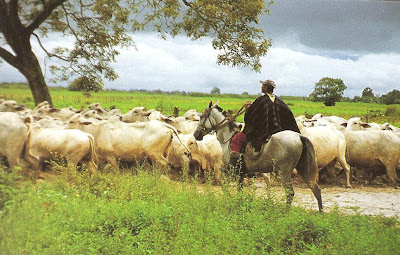
Cattle ranching are a big part of the economy in los Llanos, yet it is also the most damaging to the ecosystem.  There are currently 15million cattle in los Llanos, and to accommodate this large number pasture lands are being increased and replacing the savannas.  Another increase has been in the farming industry, mostly in maize and rice.  Not only is this causing more savanna loss, but it is also causing an endangerment of various bird species.  This is because the rice fields attract many migrant flocks of birds who damage most of the crop, and so the farmers are killing the birds.   
https://blogger.googleusercontent.com/img/b/R29vZ2xl/AVvXsEjsbHBRwJwewWFASgwHjV6XcXcAYEO-fUhjcgw_Q4pZoIxE78x1uJQojpsyF1Zc67wCJWf9FeA2wC67sHtrLmF0eoxaU5y0dxYUBUhBGNYbx9pT_AzqKFrSVTs-OHTsFCQpwy_DIWJ8YAU/s1600/arreo.jpg
 Original image can be found at: http://http://cuentaelabuelo.blogspot.com/2011_06_01_archive.html

Another negative impact is caused by deforestation and farming for the wood industry.   In the llanos in Venezuela the deforestation rate since 1975 has been 34,000 ha/year.  From 1950 to 1975 a total of 1.3million ha were deforested in the llanos of Western Venezuela, which includes Apure.  It also seems that Los Llanos has been in a state of siege by the oil industry.  A total of 3million ha of savanna has been affected by the oil industry, and that is only in the Venezuelan side of Los Llanos.  However, it has not developed quite as much yet in the Columbian llanos but it is a looming threat.  The oil industry causes damages in many ways.   The roads they build fragments habitats, they bring a risk of soil and water contamination, and also with them comes more human settlements which leads to more deforestation.  
 Original picture can be found at: http://www.caracol.com.co/noticias/economia/pacific-rubiales-reporta-nuevo-descubrimiento-de-petroleo-en-los-llanos-orientales/20091027/nota/900733.aspx

Biodiversity


 http://www.pinerotours.com/fotos_itinerarios/429-381-los_llanos_pajaros.jpg
Original image can be found at: http://www.pinerotours.com/eng/destinos_itinerario.php?id_destino=25&id_paquete=76&id_plantilla=429

Los Llanos is not as bio-diverse as the regions that surround it.  One reason for this is that the region has very few endemic species.  Most of the biodiversity that it has is concentrated in gallery forests.  The open plains are not a widely used habitat.  The following are some animals and plants of los llanos de Arauca and Apure that are worth mentioning: 

Caimán:   The Caiman, Cayman in English, is a symbolic animal of Los Llanos.  There are 5 different species present.  The two most famous being: Caiman de Orinoco and la baba.  La baba are the smallest one only reaching up to 2 meters, while the Caiman de Orinoco can reach up to 6 meters. Both live in the rivers and lakes of Los llanos. 

http://media.kunst-fuer-alle.de/img/37/m/37_2446552.jpg
 Original image may be found at: http://www.kunst-fuer-alle.de/english/fine-art/artist/image/prisma-%28f1-online%29/6248/1/189870/baba,-caiman-crocodylus,-estado-de-apure,-kaiman,-los-llanos/index.htm

White-Tailed Deer:  The only deer  that can be found in all of Los Llanos, in comparison the plains of Africa which have many more types of deer adapted to the savannas.  This is yet another example of the lack of mammalian fauna of Los Llanos in comparison to at savannas of Africa.
 
 http://farm3.staticflickr.com/2476/3878618667_2f0266c2f5_z.jpg
 Original image can be found at: http://www.flickr.com/photos/barloventomagico/3878618667/

Pirañas:   Pirañas, Piranhas in English, are fish with teeth that live in the rivers of Los Llanos.  They are one of the 12 species of carnivorous fish that are present in the rivers of South America.  They are 25cm long, but can grow to be up to 60cm.  
 http://www.casa-vieja-merida.com/tour/los_llanos/piranha.jpg
 Original image can be found at: http://www.casa-vieja-merida.com/tour/los_llanos/indexeng.shtml

Araguato (Mono Auyador):  In English it is called the howler monkey.  It is a primate that lives the los Llanos.  They live in the gallery forests, and they are in clans of 10 to 15.  The clan is made up of females, young males, juveniles, and one leading male who protects the clan.  It is called Mono Auyador, Howler monkey, because of the sound they make.  
 http://farm4.staticflickr.com/3088/2801069075_9d86ac11bf_z.jpg
 Original image can be found at: http://www.flickr.com/photos/barloventomagico/2801069075/

La Garza Real:  Heron in English. It is one of the 3 species of garzas of Los Llanos.  It has its whole body covered in white feathers.  La Garza Real is the largest of the three, and it is famous for its feathers.  Its feathers are delicate and fine, giving la Garza Real the appearance of having a veil on its back.  Since the colonial times this bird was hunted for its feathers which were very popular in Europe.  
http://www.venezuelatuya.com/natura/imagenes/039casmerodius.jpg
 Original iimage can be found at: http://www.venezuelatuya.com/natura/garza_real.htm

Moriche Palm: This palm tree is abundant in Los Llanos, and is a symbol of the region.  They grow in zones where the flow of water is smooth.  They also get their nutrients from that has been filtered by the savanna floors.  They tend to grow on is moist,swampy land. 
 http://farm8.static.flickr.com/7106/8163046311_2db4ae7300.jpg
Original image can be found at: http://farm8.static.flickr.com/7106/8163046311_2db4ae7300.jpg

El Saman: This tree is other times referred to as the tree of rain.  They cannot tolerate the cold, and they grow fast and need plenty of space.  Once fully grown the Saman can resist droughts quite well. 

http://members.inode.at/841268/llanos/saman.jpg
Original image can be found at: http://members.inode.at/841268/sllanos.html

Geography & Landscape


 Geography & Landscape:

Los Llanos covers an elongated area that runs 1200-1300 km.  It starts in Columbia in the foothills of the Andes, and follows the Orinoco River almost until the river’s delta by the sea.   Different parts of Los Llanos contain different types of vegetation and landscape.  However, the whole area is a tropical savanna due to the fact that the area has a well-defined wet and dry season and it has high temperature year round.  The plains of Arauca and Apure are in low area, and have a slight downward slope in the north-east direction.  Because of this, los llanos of Arauca and Apure collects the rainfall from the surrounding areas.  The regions have many rivers to drain the area such as the Capanaparo, Apure, Arauca, and Cinaruco Rivers.  Apure and Arauca are mostly flat plains, with a few sparse forests and few mountains.   The forests that are present are gallery forest that run along different areas of the river.  
 
 This picture shows an Arial view of los llanos de Arauca.  You clearly see the gallery forest that runs along the river.
Original image can be found at: http://media.photobucket.com/image/recent/DXR001/dzsungelreszlet800x533ARAUCA.jpg
 
The highest point in either of these two regions is no more than 125 meters.  The precipitation in these region fluctuates between 700 to 1500 mm annually.  The average annual temperature is between 26 to 30 degrees Celsius. 

Sunday, November 25, 2012

Location

Original image can be found at:

This blog deals with the Tropical Savannas located in Northern South America.  This region is called "Los Llanos," but in English they are many times called the Plains of Venezuela.  However, as you can see in the map above, the plains encompass both Venezuela and Columbia.  The is why I chose to focus more on the following two regions:
Original image can be found at:

This first region is los llanos de Apure.  Apure is located in Venezuela.

 The second region is Arauca.  Arauca is located in Columbia, and it borders the region of Apure.

The reason having both regions even though they are basically the same in biology and geography is to show that both Venezuela and Columbia tropical savannas.